

Executive Summary
Artificial intelligence (AI) is reshaping capital markets at a pace surpassing governance frameworks, workforce adaptation, and traditional role design.
In the near term, AI primarily augments professionals and improves productivity rather than replacing roles. Over time, however, its impact is more disruptive — automating standardized work, reshaping teams, and widening differentiation between high- and low-value roles.
Key Takeaways
AI augments roles first, then drives structural redesign
Relationship- and judgment-intensive roles endure longest
Leadership capability, not technology, is the primary constraint on successful adoption
Our latest report examines how AI will reshape skills and leadership requirements over the next decade with a focus on seven senior key capital markets roles:
The Current AI Landscape
AI adoption across financial services has moved rapidly from experimentation to early institutionalization.
Where AI is today in financial services
Regulators are tasked with shaping oversight, regulation, and guidance that enable responsible AI innovation and adoption in Canada, ensuring its benefits — including improved operational efficiency and accuracy, enhanced trade surveillance and market-manipulation detection, and stronger advisory and customer service capabilities — are realized while safeguarding investors and the integrity of Canada’s capital markets.
Where is focus shifting?
%
%
SOURCE: Massey Henry Executive Talent Survey 2026.
AI’s Unique Impact on Capital Markets
Capital markets roles are uniquely exposed to AI-driven disruption due to their data intensity, regulatory oversight, speed of execution, and margin pressure.
According to a KPMG (2025) Financial Planning Survey, while younger Canadians are adopting digital tools, the majority of the population still values human expertise in financial planning:
- Human Preference: 54% prefer face-to-face interaction.
- Generational Split: Baby Boomers favour human advisors (56%), Gen Z leans digital (54%).
- High Net Worth individuals strongly prefer in-person, personalized service.
- 64% of respondents say personalized, human-driven plans are essential.
Overall, empathy and expertise from in-person advisors remain critical, especially for complex or long-term planning.
SOURCE: KPMG Financial Planning Survey 2025.
Outlook for Capital Markets Roles: 2026 – 2036+
Short-Term Outlook (0–2 years)
Medium-Term Outlook (3–5 years)
Long-Term Outlook (10+ years)
Role Impact Assessment Across Capital Markets
Role-by-role summary
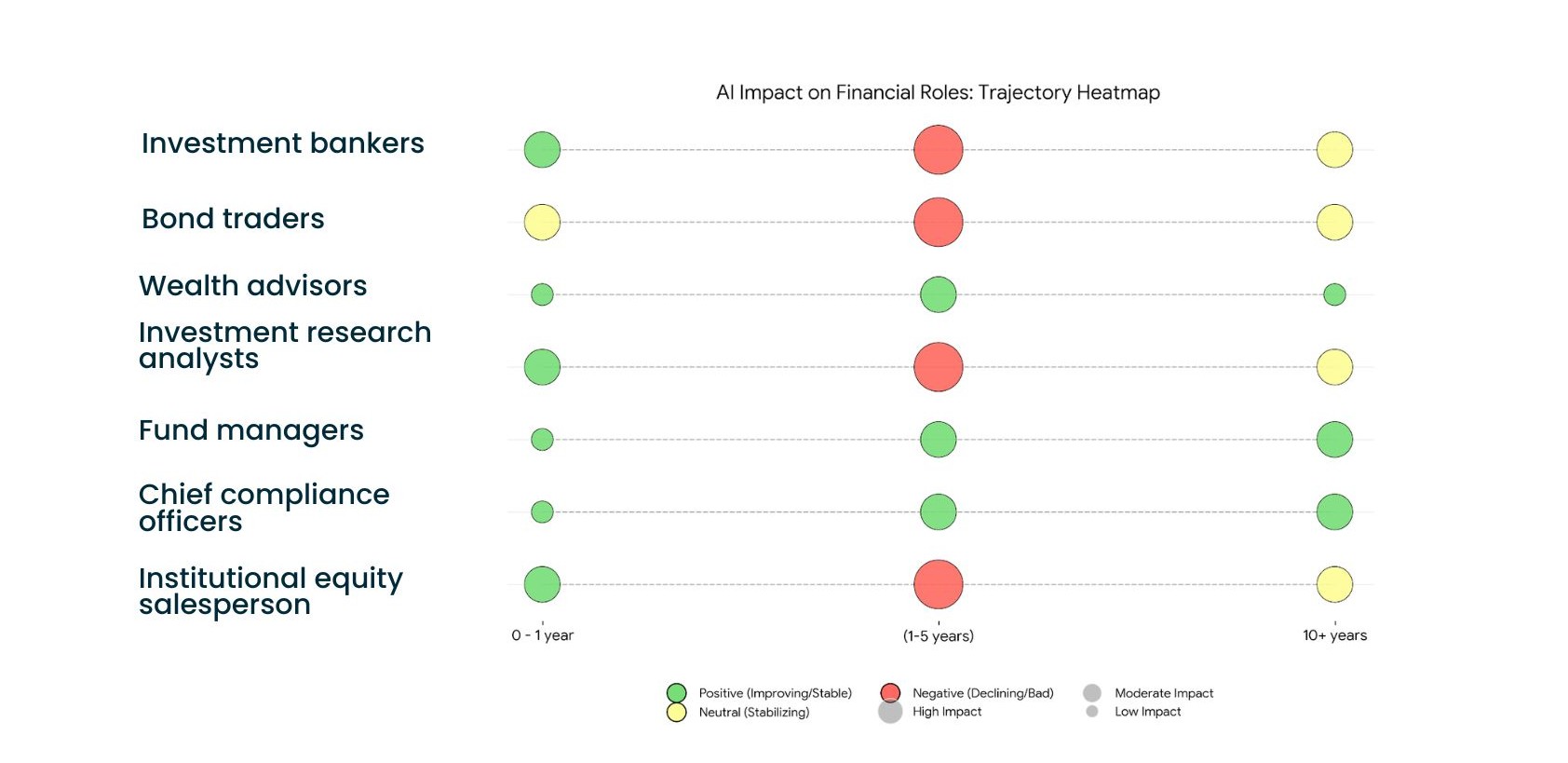
How will these roles endure in the medium-term?
High Disruption & Transformation
- Investment Bankers & Research Analysts: AI agents are rapidly taking over valuation modeling and data synthesis, leading to leaner teams and a "Negative" medium-term trajectory for traditional execution roles.
- Bond Traders & Equity Sales: These roles see early impacts as algorithmic systems handle routine work. Automation continues to compress margins in trading and sales, accelerating headcount reductions and pushing surviving roles toward advisory and specialized niches.
Stable Augmentation
- Wealth & Fund Managers: Disruption remains "Low" and "Positive" as AI automates back-office tasks like rebalancing, freeing managers to focus on client service and complex strategy.
- Chief Compliance Officers: This role evolves into a "Strategic Controller." Compliance stays stable by shifting focus from manual monitoring to the governance and auditing of the firm’s AI models.
Human Skills That Prevail
Judgment and Decision-Making Under Uncertainty
Where stakes are high and errors can be catastrophic, human judgement — even as a second-line of defense — becomes essential.
Judgment and Decision-Making Under Uncertainty
Trust-based advisory remains difficult to automate because it is fundamentally relational. Particularly in moments of market volatility, clients often seek more than information — they seek active listening and and empathetic communication. Wealth advisory demonstrates how AI can strengthen personalization, but human advisors retain responsibility for critical decisions and the establishment of trust and credibility.
Ethics, Governance, and Oversight
As AI becomes embedded across functions, leaders must think systemically about integrating technology into strategy, while managing risk, culture, and governance. AI systems replicate patterns in data, reinforcing the need for human oversight around explainability, bias, and unintended outcomes.
What Will Influence the Timeline for AI Adoption?
In Canada, stronger model risk management and accountability expectations may slow deployment but reduce downstream risk. Across institutions, talent availability and leadership comfort with AI-enabled decision-making are emerging as the most binding constraints on adoption.
Announced in Fall 2025, Canada’s Sovereign AI Compute Strategy is a multi-year initiative designed to secure domestic AI infrastructure, intellectual property, and data independence.
Several structural factors will shape the pace and trajectory of AI adoption in Canada:
Regulation & policy
Digital and technology infrastructure
Talent & workforce readiness
Economic investment climate
Public trust & social acceptance
Innovation ecosystem strength
Global competitive dynamics
Sector-specific demand
Infrastructure readiness
Talent and Executive Hiring Implications
As AI reshapes capital markets roles, executive mandates are expanding beyond traditional functional boundaries. Leaders are increasingly accountable not only for performance, but for how AI is deployed, governed, and integrated into decision-making.
Shifting Executive Mandates
Executive roles are broadening to include responsibility for AI strategy, talent transition, and ethical oversight, alongside traditional commercial objectives.
What Will Financial Services Organizations Look for in Capital Markets Leaders?
Future-ready leaders will demonstrate:
AI fluency and awareness of tools and appropriate use, without needing deep technical expertise
A track record of transformation and change leadership
Strong judgment and critical thinking
The ability to balance innovation with risk and governance
Looking Ahead
Preparing for an AI-Shaped Capital Markets Future
For professionals at all stages — from early career to executive — success will hinge on combining technical fluency with judgment, adaptability, and strategic thinking.
Organizations that recognize executive talent strategy as a core competitive lever — rather than a downstream consideration — will be best positioned to compete and thrive in an AI-shaped capital markets future.
À propos de Massey Henry
Executive Search, Coaching, Assessment, and Advisory Services

Michael Henry
Managing Partner, Massey Henry

John Sanders
Senior Partner, Board & CEO Services

Lisa Newey
Partner

Carmen Jefferey
Principal